


How Long Does It Take to Build a Website in Jersey?
If you’re thinking about getting a new website for your Jersey business, one of the first questions you’re likely to ask is:
How long will it take?
The answer depends on the size and complexity of the website, how quickly content and feedback are provided, and what needs to be included.
A straightforward business website can often be completed in a matter of weeks, while larger websites with more pages, bespoke functionality or e-commerce can take considerably longer. At Web Design Jersey, we aim to make the process straightforward, efficient and transparent — from the initial conversation through to launch.
How long does a typical business website take?
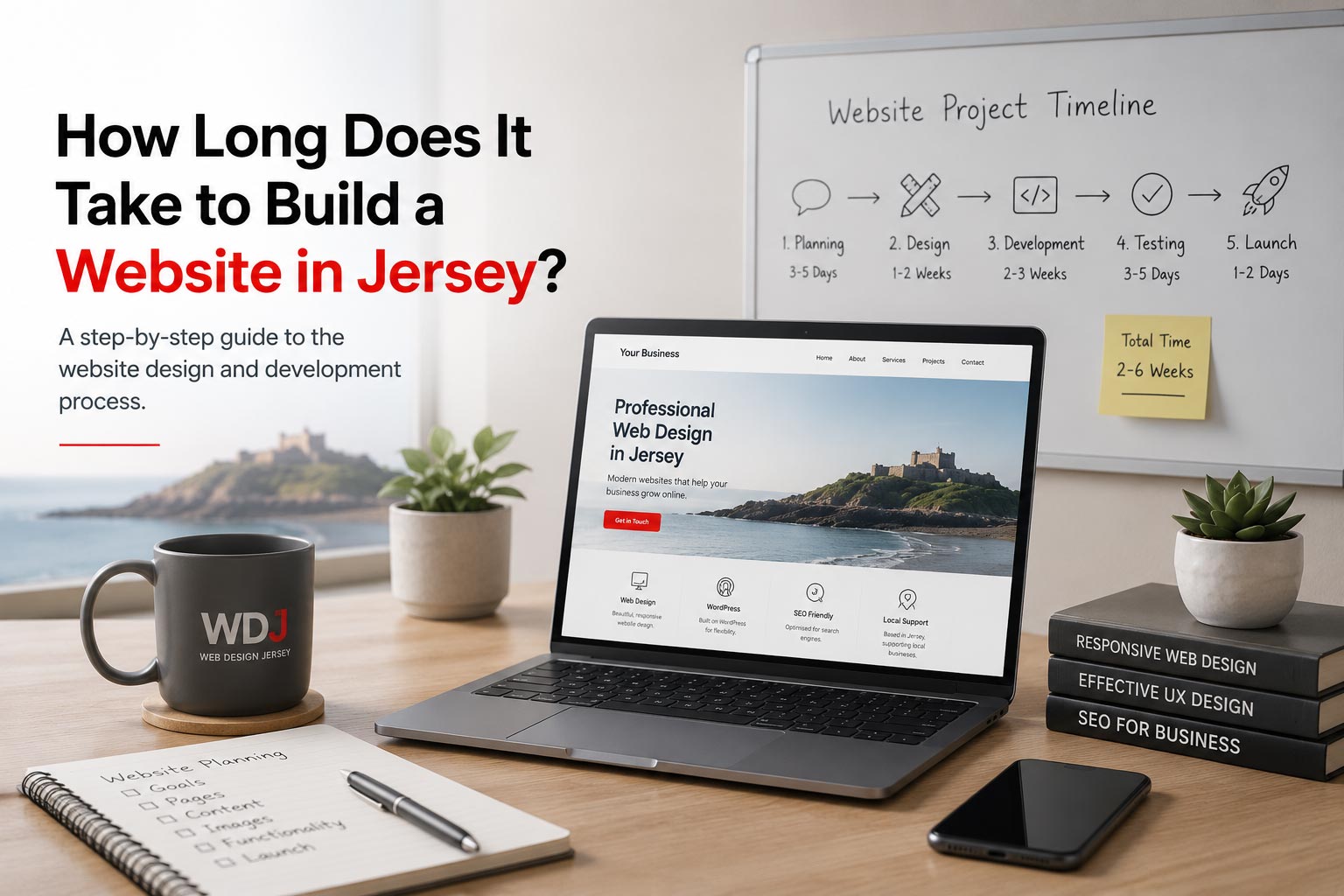
For a typical small or medium-sized Jersey business, the process can take around 2–6 weeks from the initial planning stage to launch.
This isn’t a fixed timeframe. Every project is different.
A simple brochure-style website with a handful of pages may be relatively quick to complete. A larger WordPress website with multiple services, detailed content, forms, integrations or other functionality will naturally require more time.
The biggest factor isn’t always the technical work. Having the content, images and information ready – and providing feedback promptly – can make a significant difference to how quickly a project progresses.
What happens when you build a website?
A professional website shouldn’t simply be designed and published in one step.
There are several stages involved.
1. Planning
The first stage is understanding what you need from your website.
This includes looking at:
- Your business and target audience
- The services or products you offer
- What you want visitors to do
- The pages your website needs
- Your existing branding
- Your competitors
- Your SEO requirements
- Any additional functionality
This stage provides the foundation for the rest of the project.
A website shouldn’t simply look good. It needs to have a clear purpose.
2. Website structure and content
Before the design is finalised, it’s important to establish the structure of the website.
For example, a typical Jersey business might have:
- Home
- About
- Services
- Individual service pages
- Portfolio or Our Work
- Insights
- Contact
The structure can be adapted around your business. Content is also important at this stage. Your website needs clear, useful information that tells potential customers what you do, who you help and why they should choose you.
It also gives Google the information it needs to understand what your business offers.
3. Design
Once the structure is agreed, the visual design can take shape. This includes:
- Layout
- Typography
- Colours
- Images
- Calls to action
- Navigation
- Mobile presentation
- Overall user experience
The aim is to create something that looks professional while making it easy for visitors to find what they need.
For a Jersey business, that might mean creating a design that feels local and approachable rather than looking like a generic template.
4. WordPress development
Once the design and structure are established, the website can be built.
WordPress provides a flexible platform that can be expanded as your business grows. The development stage can include:
- Page creation
- Responsive layouts
- Contact forms
- Navigation
- Image optimisation
- SEO settings
- Security features
- Analytics
- Cookie and privacy requirements
- Integration with other services
The website should be tested across different screen sizes so that it works properly on desktop, tablet and mobile devices.
5. SEO setup
SEO shouldn’t be something that is added after a website has been launched.The basic foundations should be considered during the build.
This can include:
- Page titles
- Meta descriptions
- Heading structure
- Image alt text
- Internal linking
- Search-friendly URLs
- XML sitemap
- Indexing
- Mobile usability
- Page performance
For a Jersey business, local relevance is particularly important.
Your website should make it clear to both visitors and search engines that you serve Jersey and, where appropriate, the wider Channel Islands.
6. Testing
Before launch, the website needs to be checked carefully. This includes testing:
- Links
- Contact forms
- Navigation
- Mobile layouts
- Images
- Buttons
- Page loading
- Browser compatibility
- SEO settings
- Security
- Analytics and tracking
This stage is important because small issues can easily be missed when you’re looking at a website during development.
7. Launch
Once everything has been checked and approved, the website can go live. The launch isn’t necessarily the end of the project. It’s often the beginning of the next stage – monitoring performance, adding new content, improving SEO and making updates as your business develops.
What can make a website take longer?
There are several things that can extend the timescale of a website project.
The number of pages:
A five-page website is obviously quicker to produce than a 30-page website.
If you have multiple services, locations, products or other areas that need dedicated pages, more time will be required for both content and design.
Bespoke functionality
A straightforward business website is relatively simple.
Additional functionality can increase the development time considerably. For example:
- Online shops
- Booking systems
- Membership areas
- Customer logins
- Advanced forms
- Online payments
- Third-party integrations
The more functionality a website needs, the more planning and testing is required.
Content
One of the most common causes of delays is content. If the website is waiting for:
- Written copy
- Photographs
- Logos
- Product information
- Staff profiles
- Testimonials
then development may have to pause. Having your content prepared early can significantly speed up the project.
Feedback and revisions
Website design is collaborative. There will normally be points during the project where you need to review the work and provide feedback.
The quicker feedback is provided, the easier it is to keep the project moving. Clear, consolidated feedback is particularly helpful.
Can a website be built faster?
Yes. A simple website can potentially be produced relatively quickly when:
- The scope is clear
- The content is ready
- Branding is established
- Images are available
- Decisions are made promptly
- The website doesn’t require complex functionality
However, faster isn’t always better. A website that is rushed can result in:
- Poor content
- Weak SEO
- Inconsistent design
- Missed technical issues
- A confusing user experience
The objective should be to create the right website, not simply the fastest website.
How long should you expect your website to last?
A good website shouldn’t need to be completely replaced every couple of years.
A professionally designed WordPress website can provide a strong foundation for a business for many years, provided that it is maintained, updated and developed as the business changes. Over time, you may want to:
- Add new services
- Publish Insights
- Improve SEO
- Add new functionality
- Refresh images
- Update your branding
- Improve conversion rates
This is one reason why it’s worth building the website properly from the beginning.
What can you do to get your website launched sooner?
If you’re keen to get your new website live, there are several things you can prepare before the project starts.
Have your branding ready
Make sure you have your logo, colours and any brand guidelines available.
Prepare your content
Start thinking about the key information you want on each page.
Don’t worry if it’s not perfect — content can be refined during the project.
Gather your images
Good photography can make a huge difference to a website.
Collect any relevant:
- Business photographs
- Product images
- Team photographs
- Premises photographs
- Previous project images
Make a list of your requirements
Think about anything the website needs to do beyond displaying information.
For example:
“We need customers to be able to request a quote.”
or:
“We need people to be able to book an appointment.”
Knowing this at the beginning makes planning much easier.
A typical website project in Jersey
For a straightforward business website, the process might look something like this:
Week 1: Planning & structure
We discuss your business, requirements, pages, audience and objectives.
Week 2: Design
The visual direction and page layouts are developed.
Weeks 2-4: Development
The website is built, content added and responsive layouts created.
Week 4-5: Testing & revisions
The website is reviewed, tested and refined.
Week 5-6: Launch
Final checks are completed and the website goes live.
Some projects will be considerably quicker. Others will take longer. The important thing is to agree on a realistic scope and timescale before work begins.
Related Articles
You may also find these guides helpful:
Looking for web design in Jersey?
If you’re considering a new website, you don’t need to have everything worked out before getting in touch.
We can discuss what you’re trying to achieve, how many pages you need, what functionality is required and what sort of timescale would be realistic for your project.
At Web Design Jersey, we provide professional website design, WordPress websites, web hosting, domain registration and ongoing support for businesses, clubs and charities across Jersey.
Whether you need a completely new website or you’re looking to replace an outdated one, we’d be happy to discuss your requirements.